My Love Affair with German Food

Monday, January 6, 2014

I'm going to be honest and say that I'm not the biggest carnivore the world has ever seen. I go through meat phases, but generally avoid pork because it's just how I was raised. I knew that traveling to Germany would be a meat-filled experience, so I told myself I was just going to let everything go and embrace the meats. And boy, I'm so glad I did.

I'm going to go through some German specialties and local phenomenons I experienced.

First of all, the bakeries. You couldn't go anywhere without passing at least two Baeckerei. The bakery is the place to be, pretty much anytime before dinner. You stop in on your way to work or school for a coffee and a pastry. I can tell you that Schokocroissants were my sweet standby, but I also switched it up and got apple pastries, almond pastries, or when spring hit, rhubarb pastries! There was the sweet and also, perhaps even more importantly, the savory. Brezeln (Pretzels). Butterbrezeln. The Germans do amazing things with pretzels. They slice them in half and spread them with gobs of butter. They cover them with melted cheese and little bits of ham. Sometimes they make sandwiches out of them. Then, there's Lauge-anything, which I interpreted to be pretzel bread. Laugenbroetchen (lye rolls) or Laugenstange (lye baguettes--literally "sticks"), gorgeous, shiny brown breads with chewy soft centers, topped with salt. Many places made sandwiches, and indeed I purchased many a Laugenstange sandwich from the little cafe in the forestry school building where I had my Uni classes.

This is a Laugenstange. The sight of it nearly brings me to tears.

This brings me to an important note, on German use of condiments. In Germany, butter is the condiment most used on sandwiches. Meat, cheese, lettuce, tomato, butter. I have to admit I was a little bit weirded out when I first noticed that I was eating gobs of butter, not mayonnaise, but I learned to love it. And mustard is reserved for Wurst. 

Back to bakeries, everything is lined up behind the glass and when it's gone, it's gone. By late afternoon there's just a few things left, and the bakeries close up shop as soon as their products are gone. 

German bread is in my opinion, without equal. The bakers created such dense, hearty loaves of bread, sometimes studded with every kind of seed imaginable. A sandwich on German bread, or even just a slice of toast with a smear of Nutella (my breakfast every morning), is unparalleled by anything American. Pre-sliced sandwich bread isn't really a thing in Germany. People go to the bakery, or the open-air market, or the separate bakery part of every grocery store for their daily bread. And if you happen to shop at Aldi, they've got an amazing Brotautomat, which is basically a bread vending machine. You press the button next to the picture of the bread you want, and out pops a fresh loaf, still steaming.

The Aldi Brotautomat. Press button. Get bread.

I would buy the densest, seediest, most whole-grain loaf of bread I could find, which means I got a lot of Dinkelvollkorn Brot, which I guess translates to "whole grain spelt?" When I was feeling on the lighter side, I'd go for Bauernbrot, which translates to "farmer bread," which was more of a sourdough. A lot of the loaves were small and square, I wonder if it's because people would buy their bread daily and want only what they could eat in a day or two before it got stale. Pre-sliced sandwich bread was not a big thing at all, in fact prepackaged bread in general was slim in grocery stores. If you bought bread at the grocery store, you bought it at the separate bakery at the front of the store.
Oh, the bread offerings!

My favorite breakfast/snack.

Such good bread.


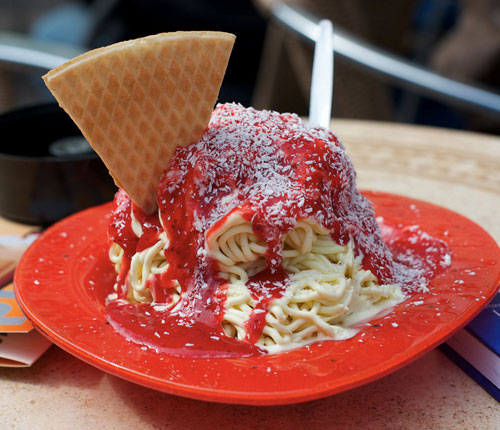
Germans seem to have an obsession with Eis. Ice cream. There were Eiscafes everywhere in Freiburg, and I was fortunate to live in the neighborhood of Limette, arguably one of the best ice cream places in town. There were 0,90 Euro Kugeln (scoops) everywhere, so I spent a lot of my loose change on Eis. Eiscafes generally serve a variety of coffee drinks, as well as coffee+ ice cream drinks, and amazing ice cream sundaes and creations. In Germany, ice cream is ART. Most ice cream dishes come artfully arranged with slices of fruit and a wafer cookie sticking out, but by far the most interesting phenomenon is Spaghettieis. It's an ice cream sundae made to look like spaghetti: a mound of whipped cream covered with a tangle of spaghetti-like strands of vanilla ice cream, topped with a strawberry sauce for marinara, and white chocolate shavings for parmesan. Every Eiscafe worth its weight in salt features Spaghettieis on its menu. One of the fancier places in town, Cafe Incontro, had a whole section of its menu reserved for meals recreated in ice cream: I'm pretty sure they had lasagne and pizza and all sorts of things; wish I took a picture of the menu. Even in cool weather, I would see tons of Germans walking around with ice cream cones. When my Ecology professor told my group how to get to our research site, he oriented us based where the nearest ice cream shop was, and he told us we had to stop there to try the Eis. So we did, every day after we collected our samples.

A quick search for "Eiskarte" (ice cream menu) yields results like this.
So many varieties of Spaghettieis!


Here's a closeup, so I can prove I'm not lying to you.


Germans also have a wondeful afternoon tradition of Kaffee und Kuchen (coffee and cake), sometimes called Kaffeklatsch. Between lunch and dinner, people gather for a break and enjoy a cup of hot coffee or tea and a slice of cake. It was a really nice excuse to eat dessert at 4pm.

Kaffe und Kuchen exhibit A.

Kaffee und Kuchen exhibit B. 
Kaffee und Kuchen exhibit C, at the Ritter Sport Bunte-Schockowelt factory in Berlin.

Speaking of Ritter Sport, that was my favorite German chocolate. Thick square bars of chocolate with clever resealable packages; it quickly became our mission to try every single variety. We were lucky enough to stumble upon a Ritter Sport factory store in Berlin, which pretty much made my life.

One time I decided to save all of my Ritter Sport wrappers to see how much I ate, and that was a very bad idea. 


Finally, no discussion of German food would be complete without Wurst. Sausage, duh! Every region of Germany has its own special variety of Wurst, but I couldn't really keep them straight. There were red ones and brown ones and white ones, spicy ones and pork ones and lamb ones and fat ones and little tiny ones, ones you ate in a roll with mustard and ones you ate with a fork and knife with potato salad and greens. There were also ones filled with cheese. There's also Currywurst, which is really big in Berlin: steamed, then fried cut-up sausage with curry ketchup. In Freiburg, the best and cheapest lunch was Wurst from the Muenstermarkt; the daily farmer's market outside of the cathedral. You could tell where the best place to go based on how long the line was: I think Pauls was generally thought of as the best.
Wurst from the Muensterplatz. Hot dog buns are not a thing. Your Wurst will stick out of the bread, sometimes a lot. 

Currywurst mit Pommes. French fries are served with mayonnaise in Europe.

I'll be honest, I found Bavarian Weisswurst to be pretty weird. It's white and spongy and boiled. It's said you have to eat it before noon because it's traditionally made in the morning and is super perishable.

But WAIT. I forgot one of my most important discoveries of all: doener kebab, and a brief lesson in German-Turkish history! So Germany has a huge population of Turkish people, mostly because it opened up the country to Gastarbeiter ("guest workers") to help rebuild the nation's infrastructure after it got razed in World War II. Lots of Turkish people (and also Italians) moved to Germany to work, some just made money and then went back home, others remained in Germany. Turkish food is basically the Mexican food of Europe...it's cheap fast food available in lots of places, especially Germany. The specialty is Doener Kebap, meat shaved from a vertical rotisserie and served in a pita or wrapped in a tortilla-like bread called a Yufka with a red cabbage slaw, onions, cucumber, a garlic yogurt sauce, and chili flakes. It comes in lamb, veal, or chicken variety and quickly became one of my favorite meals. Doner places were very popular with the young crowd and were the restaurants open the latest, so I enjoyed many a Doner on my way home from the bars... The Turkish restaurants also served great falafel, amazing salads, and baklava. There was a strict division among my friends about which place served the best doener in Freiburg: Euphrat or Uni-Doener.

See? Even Angela Merkel likes Doener.
One of the many ways to eat a Doener. 


Fields of Gold

Monday, December 16, 2013

In Germany (and on the continent in general), most people travel by train. I became an expert trip planner using the DeutscheBahn website, and greatly enjoyed watching the German countryside fly by me out the window as I reclined on their clean and efficient trains. One thing I saw a lot of was rapeseed, which seemed to be one of the main crops around Europe. I was so used to seeing fields of corn in the US, none of which I saw while traveling abroad. In Europe, it was grains and rapeseed, which lit up the Earth with tiny yellow flowers. So much of what I saw out of train windows was fields of gold.

Everything looked like this. 

Did I ever mention that in Freiburg, they covered the landfill with solar panels?

Sunday, November 17, 2013

It made so much sense, it actually brought tears to my eyes when I saw it.
Germany is one of the world leaders in recycling, and has very few active landfills anymore because they're so good at waste management and also have much stricter regulations. So what do you do with a closed landfill? When you're Freiburg, the solar energy capital of Europe, you slap some solar panels on it and do great things!

The city also collects expired/damaged produce and turns it into biogas.

Our class trips to Freiburg's businesses and government operations gave me faith in humanity. They're doing everything right, and are actually combating climate change. Renewable energy everywhere you look, amazing public transportation, a city planned with a human scale in mind, responsible banks and businesses...it's beautiful.


Living in a Dream World

Tuesday, October 29, 2013


Germany just made sense to me. The stereotypes about German engineering and efficiency are true, especially in Freiburg. I lived in a dream world, where everything worked. Let me break it down for you.

I lived in:
Vauban, the most ecologically sustainable neighborhood in
Freiburg, the greenest city in Germany, which is located in the state of
Baden-Wuerttemberg, the richest state in
Germany, a highly developed  and powerful country with one of the world's largest economies.

The larger German economy didn't really become apparent to me until I traveled to Rome, which frankly, I found to be dirty, inefficient, and with incredibly incompetent and frustrating public transportation systems. It took me one step off the plan to become aware of the difference in the state of economy in Italy compared to Germany. I was never so glad to be in Germany as when I arrived in Berlin from Rome and was greeted with an airport full of immaculately clean (fee-charging) bathrooms, ample recycling stations, and a vast yet easily navigable public transportation system. I don't mean to rag on Italy, but I just had such a different experience that I wasn't necessarily prepared for. The differences were so stark I couldn't help but point them out and think about them.

Vauban was a very interesting neighborhood with a really turbulent history. I lived in the Studentendorf, housing owned and managed by the university. The oldest buildings in Vauban, which comprised most of the Studentendorf, were French military barracks from World War II, because Freiburg was in the French occupied zone. I lived in one of them, in a six-person apartment.

150/06, converted military barrack and my home for four months.

If you don't believe me, check out the gun rack we had recessed into the wall of the common area of the apartment.


Vauban is a vibrant area of town. In addition to the student housing, there is regular family housing and the SuSi, a commune of sorts. There's quite an interesting political history in Freiburg that is now mostly concealed by agreements and new construction. See, decades ago, after the French left town, the area was occupied by squatters, both in the old military buildings and in caravans on the grounds. At some point the city came in and decided to reclaim the buildings, and there was a big battle between the city and the squatters. The city agreed to let the squatters keep two of the buildings, and in them the SuSi was born. SuSi is an acronym that stands for "Selbst-Organisierte Unabhaengige Siedlungs Initiative," which basically translates to "self-organized independent settlement initiative." It's easy to tell which buildings belong to the SuSi, because they have brightly painted murals, grounds covered with interesting recycled art, highly
decorated balconies and staircases, and are surrounded by old vans and RVs that people live and work in.
I walked through the SuSi every day on my way to the tram stop. 

Pippi Longstocking is one of the mascots of Vauban.

The SuSi proved to make very interesting neighbors. There were some students there, but mostly families, and fairly ethnically diverse ones at that. It became a completely normal thing for me to see all kinds of folk around: children with dreadlocks riding unicycles, groups of people on stilts, people wearing all kinds of harem pants and flowy clothing playing outside barefoot. They had really interesting wooden playgrounds, mysterious art installations (this giant white dragon thing made out of lights and umbrellas for the 1st of May celebrations...I wish I had a picture of that), and at the end of my stay, the craziest parties. 2013 marks the 20th anniversary of the SuSi, and so they had the most fantastic three day celebration one weekend. It was like a music festival in my own backyard, except with even crazier decorations. The week leading up to the party, my walk down the street through SuSi included a stroll down a purple carpet under curtains of tinsel blowing in the wind, with mannequins with animal heads and wings guarding the path.

One of the last squatter strongholds in the area was this area called "Rhino," which was basically a lot full of vans and RVs and small buildings and art. The city kicked them out to build a new, super "green" hotel, which was being completed when I was living there. I could still see the scars of Rhino though, with signs saying "I miss Rhino" tied to the fence around the construction area, or Rhino-related sayings being graffitied onto buildings and signs in the area. If you look it up on the internet, the Rhino controversy looks like a pretty big deal:


Rhino used to exist along the tram lines in Vauban.
Here you can see it getting pretty politicized, surrounded by signs and banners.

The people did not let go of Rhino without a fight. There were riots and police activity. 

There are pictures of riots on the website for the state newspaper, Die Badische Zeitung.

And now, where the free citizens of Rhino used to dwell, there's this:
Hotel Vauban, a brand new, just-opened, super modern and green hotel.


Vauban was an amazing place though. I need to get back to telling you how awesome it was. It's basically an urban planning experiment to see how people can live without cars: there is a solar parking garage on the outskirts of Vauban, and there was a small parking lot in the Studentendorf, but other than that, there were no cars inside of the neighborhood. All of the streets were very narrow and pedestrian-oriented, and named after scientists and philosphers and authors, which was pretty cool. Nobody really had a yard like they do in American suburbs, rather people lived together in ecologically designed buildings and used their balconies/doorsteps/rooftop terraces to the fullest advantage and covered them with plants and lights. There was lots of beautiful common space interspersed between all of the houses: several playgrounds, gardens, lots of trees, grassy areas with fire pits. The Strassenbahn (tram/streetcar) had four stops in the area, and there were also bus stops. I lived equidistant from two tram stops, and had about a 4 minute walk to get to public transportation every day.


I should mention that everybody in Freiburg bikes. There are bikes everywhere: in nice bike shelters, along railings, on balconies, whatever. There are well-marked bike lanes on the street and definitely a big bike culture there. The law says you have to have working front and back lights on your bicycle, and I know more than one person who has gotten a bike-DUI. 

Freiburg was set up on a very human scale. What I mean by that is that the infrastructure is such that every neighborhood has its immediate needs taken care of. In my neighborhood, there were three grocery stores (including AlNatura, perhaps a smaller, German version of Whole Foods), a bank, a drugstore, a bakery, a couple of restaurants (including a Doener place, Doener kebab being the most popular type of fast food in Germany), an ice cream place, a bike shop, and a small department store. You can walk to everything and easily get what you need without having to take three buses across town or drive to a strip mall on the edge of town like you do anywhere in America. People buy only what they can carry, and so I went to the grocery store every couple of days to get food, instead of stocking up on two weeks' worth of food like I do at home. The refrigerators are smaller, too. The six people in my apartment shared two glorified mini-fridges, so I couldn't hog the whole fridge with a week's worth of food or anything. 

Nature was also extremely accessible. Vauban is on the edge of town in the shadow of beautiful Black Forest hills. I just had to follow the path out my back door, walk a few blocks, and then start ascending the huge grassy hills that were a combination of fields and vineyards, eventually giving way to forest. I had some amazing hikes in those hills, my favorite places to go to being the tiny hamlet of Schoenberg, and the ruins of castle Schneeberg above it. There were medieval castle ruins practically in my backyard! It was amazing.

Here are some photos from my hikes:
The path out of Freiburg and through the hills of Merzhausen

The hills are covered with vineyards

The ruins of Schloss Schneeberg

Visiting Schneeberg

Looking down on the city of Freiburg

Freiburg from a castle window


Small Moments of Triumph

Saturday, October 26, 2013

As an Auslaenderin (foreigner), my time abroad was colored by little victories and embarrassing mistakes.

Some everyday stuff was hard for me. I could never get through the lines at Aldi as quickly and efficiently as the real Germans. It sounds funny, but the checkout at that place was actually kind of intimidating. It took me awhile to fully understand recycling and deposits. I once spent entirely too long unsuccessfully putting beer bottles into the recycling machine at REWE (my neighborhood grocery store) and having them shoot back out at me, while lots of Germans walked by me and looked amused but did not stop to comment or advise me that I was trying to put glass into the plastic machine. I lugged my huge bag of clanking glass bottles back to my apartment, truly tempted to just chuck them all into the recycling bin and forget about the Pfand (deposit) money, but they were too valuable so I carried them back to my third-floor apartment. I swallowed my pride and asked my German roommates, who told me "The glass machine is at the back of the store, silly!"

Cooking and baking with the metric system was strange. Our measuring equipment was in grams and milliliters, with different measurements used for flour, sugar, etc. I was lucky that our cupboards also contained American measuring cups, and I mostly stuck to those. It took me almost two months to brave using the oven, because it had really unintelligible settings without words, which were combinations of lines, squiggles, and triangles.
Honestly, words would have been much easier to translate than cryptic symbols. Where's "Bake" and "Broil"?

Getting on public transportation, I always struggled with whether or not to show the driver/conductor my ticket. Germany works on the honor system, where you just get on and only show your ticket if the conductor comes around. It's much faster and more efficient that way. But whenever I went to other countries, I never knew what I was supposed to do when I got on the bus. Whip out my ticket like a tourist, or risk being reprimanded. 

This is neither here nor there, but the local transit authority in Freiburg was abbreviated VAG. Us Americans loved it, and enjoyed posing by the bus stops that said "VAG" in huge letters, and joked about getting our hands on some VAG apparel. You can probably guess how we pronounced it. The Germans pronounced it by its letters, "V-A-G," "fowh-ah-gay." The VAG was one of the best things about Freiburg, truly. They were so cutting edge with green technology and ease of access and city planning. I wish everybody had a VAG.

On to the triumphs:

I never appreciated Germany so much as when I went to Italy. I don't speak a word of Italian, and of the places I visited, the Italians seemed to be the least likely to speak English. I spent several days in Rome, which honestly, I found to be dirty, poorly organized, and really overwhelming. Within 5 seconds of being in Rome, the economic status of the country became pretty clear to me. It just felt really clearly different from Germany. Their subways stopped running at 11:30pm, and did not have convenient stops near the major tourist destinations in the city, and I found their bus system to be poorly labeled. I just felt so helpless there, and getting lost was a lot scarier than it was in Germany. I flew from Rome to Berlin, and even though I had never been to Berlin before, it felt like I was coming home. Berlin opened its arms to me like an old friend, and even though the city itself is a giant, sprawling metropolis, it is held together by a complex, yet incredibly organized system of public transportation. After being in a place where I did not know the language, when I went to Berlin I suddenly had a lot more faith in my German skills. Anything was better than Italy, where I could barely even say "thank you." Nothing like being a fish completely out of water to make you appreciate what skills you do have. 

People.

Sunday, October 13, 2013

I encountered several types of people in Germany.

The first were American tourists. Technically I was one of those, but I was a university student living with other German university students and had a mission to blend in and act "German." I also spoke German. Some of the other Americans in my program could be a little obnoxious at times, but nothing like some of the situations I witnessed. One of the main stereotype Germans have about Americans is that Americans are LOUD. And actually, loud we are. I can't tell you how many times I was on a train somewhere or out at night and encountered a really, really loud group of (usually drunk) Americans bragging about stupid things or just being generally embarrassing. Sometimes they seemed just really uninterested in local culture--I think probably because lots of young people travel/study abroad to drink and party, and really take advantage of the super young drinking age in Germany.

And then, there were the Erasmus students. Prior to moving to Germany, I had never heard of Erasmus before, but it's basically EU study abroad. It stands for European Community Action Scheme for the Mobility of University Students, and is an exchange program to encourage university students to travel and study in other countries in the European Union. I met a bunch of them in my German classes at the Uni, and they all lived together in one of the student housing areas called the StuSie. They quickly banned together and formed a pretty formidable group: students from England, Scotland, Belgium, Italy, and France mostly. The UK kids dominated. Erasmus seems like a crazy party semester, and when the Erasmus kids took over bars, they took over bars. They came to Vaubar, the small bar next door to me, and drank them out of alcohol on more than one occasion. I thought Americans were obnoxious partiers, but Erasmus students are on a pretty equal level. My Erasmus friends also went on several crazy party trips, to Prague and also to Greece...regrettably I couldn't go on either of those trips for one reason or another, but something tells me I might not have survived at the pace at which they partied. Seriously intense.

Freiburg also had a pretty decent population of students from Spain. Germany is pretty much single-handedly holding up the EU economy right now, and my interpretation of the situation is that lots of people from Spain are funneling into Germany to get a better education and a good job. They don't necessarily speak German, either. Most speak more English than German.

And then, there are the Japanese exchange students. They throw up peace signs next to their faces in every picture, and they take a lot of pictures. There were more students from Japan than any other country in my month-long Sprachkurs (language course) that I took at the university before the semester began. A lot of them were very shy, much moreso than the Europeans. They liked to travel in packs.


Only Americans

Saturday, October 5, 2013

Sometimes weird stuff happened to me because I was American. People treated me differently, or asked me really pointed questions, one of which was:

"But why Germany? Why would you want to come here?"

I could never tell if they were just really self conscious about what people thought about Germans, or if they thought their country was really boring, or if it was some kind of test.

Second to that was:

"Do you have a gun?"

No comment.

And a small thought on geography:
And they say Americans are the worst at geography, but the average European I met thought that New York automatically meant the city, or that I was near it. Nope. Also, Connecticut? Forget about it. My German roommates only knew about Connecticut because they watched Gilmore Girls.